PROJECT STUDY
PrototypeLogistics Intelligent
Plan deliveries and stock around a changing day.
A dispatch and supply-planning prototype for delivery routes, fleet disruptions, and retail replenishment across multiple warehouses.
Explore the build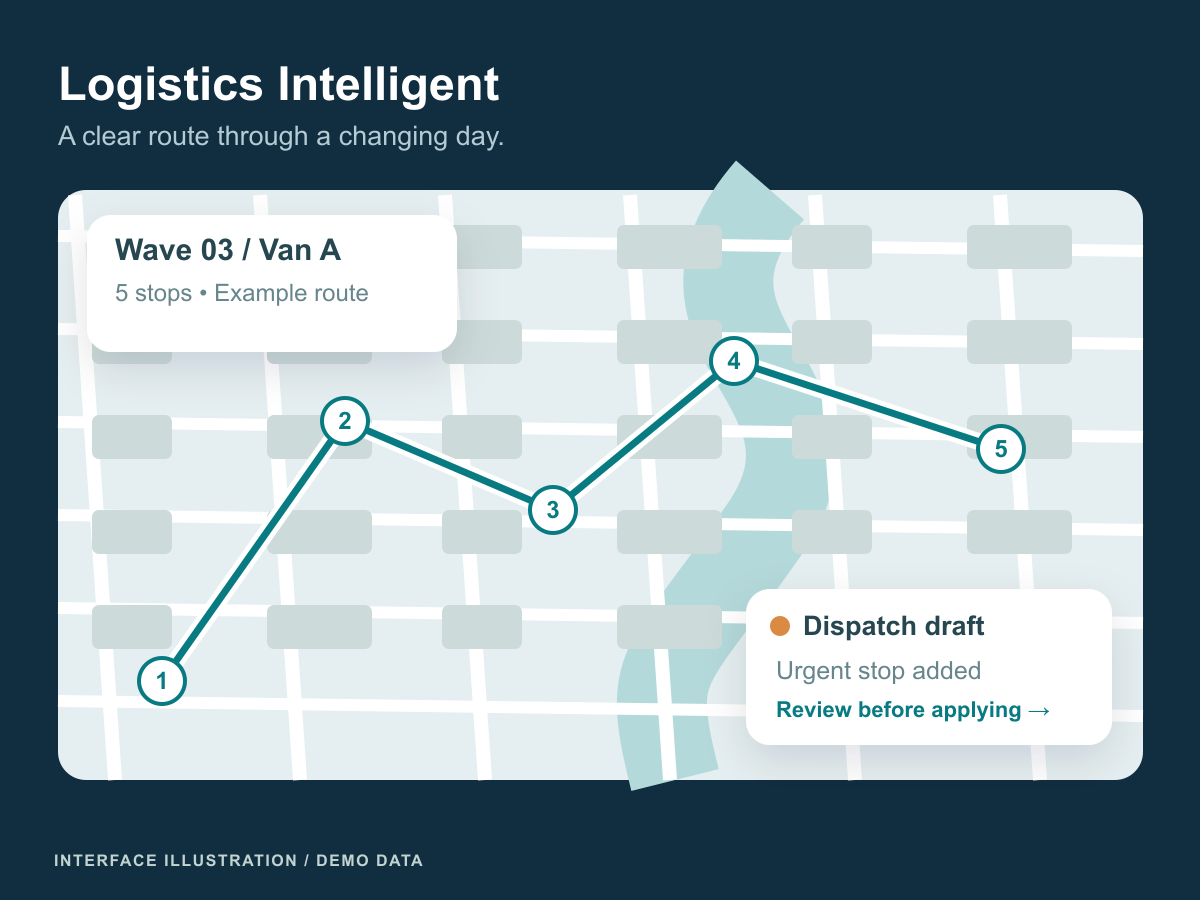
At a glance
- Stage
- Prototype
- Industry
- Logistics
- Context
- Internal product
- Capabilities
- 6
- Technologies
- 10
- Year
- 2026
Historical planning benchmark for 1,000 synthetic stops and 60 vehicles on a development laptop; soft deadlines were not all met
Historical replenishment benchmark for a synthetic network of 5,000 stores and 10 distribution centres; this is not a live fleet result
The challenge
A delivery plan changes throughout the day.
Urgent orders arrive, traffic builds, vehicles break down and a stop can take longer than expected. Dispatchers need to adjust the plan while keeping drivers informed and customer commitments visible.
Retail supply adds another layer: which warehouse should serve each store, what stock will run out, and when an emergency delivery or purchase order is needed.
What we built
Logistics Intelligent connects daily delivery execution with retail stock and supply planning.
A planner for real operating rules
Orders, delivery windows, vehicle capacity, driver shifts, breaks and skills feed a route-planning engine. Dispatchers can review plans and lock decisions that should be preserved
A control tower for the day ahead
A map, fleet status, alerts and at-risk deliveries help the team spot problems and choose the next action
Changes with approval
Urgent orders, cancellations, delays and breakdowns produce concrete route-change proposals. Small changes can be applied automatically; larger changes need dispatcher approval. Version checks prevent an older proposal from overwriting a newer plan
Driver workflows
The Flutter app code includes route caching, queued offline events, proof of delivery and synchronisation handling
Multi-warehouse replenishment
Forecasts, inventory freshness, store-to-warehouse selection and truck routing work together to plan deliveries across the network
Stock and procurement
Stock-out risk, emergency requests, transfer suggestions and peak-season preparation connect to buyer-approved purchase orders. Supplier receipts update inventory and lead-time estimates
A planner for real operating rules
Orders, delivery windows, vehicle capacity, driver shifts, breaks and skills feed a route-planning engine. Dispatchers can review plans and lock decisions that should be preserved
A control tower for the day ahead
A map, fleet status, alerts and at-risk deliveries help the team spot problems and choose the next action
Changes with approval
Urgent orders, cancellations, delays and breakdowns produce concrete route-change proposals. Small changes can be applied automatically; larger changes need dispatcher approval. Version checks prevent an older proposal from overwriting a newer plan
Driver workflows
The Flutter app code includes route caching, queued offline events, proof of delivery and synchronisation handling
Multi-warehouse replenishment
Forecasts, inventory freshness, store-to-warehouse selection and truck routing work together to plan deliveries across the network
Stock and procurement
Stock-out risk, emergency requests, transfer suggestions and peak-season preparation connect to buyer-approved purchase orders. Supplier receipts update inventory and lead-time estimates
How it works
Plan and execution together
The platform keeps delivery planning, live exceptions and plan-versus-actual analytics together. Operations can also compare network scenarios and investigate why a route or sourcing choice was proposed.
Integrations with fallback paths
Maps, notifications, telematics and model providers are integrations with fallback paths. The core demo can run without those external services.
Current stage
Prototype
- Research
- Prototype
- Pilot
- Production
This is an internal engineering prototype with synthetic route and network benchmarks. A documented development-laptop run planned 1,000 stops across 60 vehicles in 45.6 seconds, although 221 visits missed their soft deadlines. A separate 5,000-store replenishment run took 15.6 minutes; 10% of visits arrived after the receiving window but within its configured tolerance.
Read the full status
These are historical development measurements, not customer savings or production fleet guarantees. The documented throughput checks used a single API process on SQLite. The native driver app, real map interactions and external-service deployments still need validation, followed by a live operational pilot.
Where this fits
Teams coordinating vehicles, stores and warehouses benefit from a shared planning workflow and clear change control. See our business systems, AI solutions and logistics work, or talk through your operation.
KEEP EXPLORING
Another problem. A different approach.
Let’s connect the dots
Let's put these ideas to work.
Share a process, product, or problem you want to improve. We will work through the possibilities together.