PROJECT STUDY
PrototypeCVAT Ball Auto-Labelling
Find the small ball. Keep annotations editable.
A custom CVAT adapter combining full-frame and tiled inference for small footballs, producing editable ball and person annotations.
Explore the build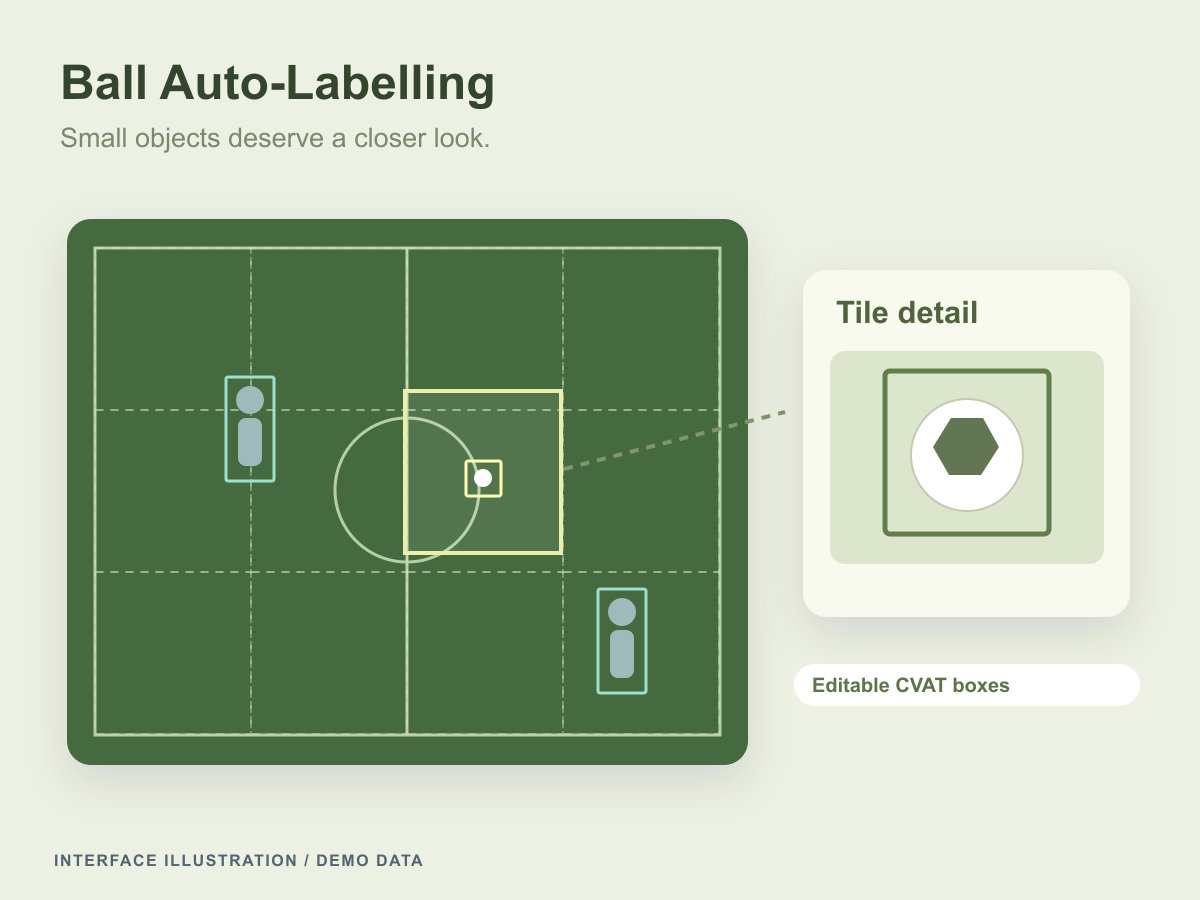
At a glance
- Stage
- Prototype
- Industry
- Sports
- Context
- Internal product
- Capabilities
- 6
- Technologies
- 10
- Year
- 2026
The challenge
Small objects can be difficult to detect in wide camera views.
When a football occupies only a small part of the original frame, resizing the whole image for inference can remove useful detail.
This prototype explores a more focused pre-labelling workflow. The goal is to supply editable suggestions in an annotator's existing tool, while leaving the final labels to a person.
What we built
The original work is a custom detector adapter and its integration tooling:
Full-frame detection
A pretrained Ultralytics YOLO model supplies person and sports-ball detections
A ball-focused tiled pass
Overlapping crops let the detector inspect smaller regions before mapping the resulting boxes back to full-frame coordinates
Duplicate suppression
Class-aware non-maximum suppression merges detections from both passes. An optional configuration can limit the number of retained ball suggestions
CVAT-compatible output
The adapter returns rectangles, labels, and confidence scores in the format expected by CVAT's serverless detector integration
Deployment configuration
A Nuclio function definition and PowerShell helpers describe the GPU container and local CVAT serverless setup
Comparison tooling
A bake-off script can compare input sizes and tiling configurations on sampled frames, recording timings and detection overlays for review
Full-frame detection
A pretrained Ultralytics YOLO model supplies person and sports-ball detections
A ball-focused tiled pass
Overlapping crops let the detector inspect smaller regions before mapping the resulting boxes back to full-frame coordinates
Duplicate suppression
Class-aware non-maximum suppression merges detections from both passes. An optional configuration can limit the number of retained ball suggestions
CVAT-compatible output
The adapter returns rectangles, labels, and confidence scores in the format expected by CVAT's serverless detector integration
Deployment configuration
A Nuclio function definition and PowerShell helpers describe the GPU container and local CVAT serverless setup
Comparison tooling
A bake-off script can compare input sizes and tiling configurations on sampled frames, recording timings and detection overlays for review
The detector proposes annotations. A human annotator can accept, adjust, or delete those boxes.
How it works
CVAT and a Nuclio handler
CVAT Community supplies the third-party annotation and review platform. The custom Nuclio handler decodes an image request and passes it to the detector with the chosen threshold.
Full-frame and crop passes
The full-frame pass and ball-only crop passes share the same model handler. Crop detections are translated into the original image coordinate system, combined with the full-frame detections, and reduced to a merged set of boxes before the response is returned.
A pretrained model
The implementation uses a pretrained model; it does not demonstrate a newly trained football model, player identification, long-term tracking, or ball-action understanding.
Current stage
Prototype
- Research
- Prototype
- Pilot
- Production
This is an implemented integration prototype. The Python adapter, function configuration, deployment helpers, and comparison script are present in the source. The source review did not execute the GPU workload, start the CVAT deployment, inspect private video, or verify benchmark results.
Read the full status
No accuracy, recall, speed improvement, or annotation-time reduction is claimed. A next evaluation would use permission-safe footage and review both missed objects and incorrect suggestions before making a deployment decision.
Platform attribution
CVAT Community is an upstream open-source product by the CVAT project. Weaveward's work described here is the custom detection adapter, tiling and merge workflow, and integration tooling. CVAT and the pretrained model are third-party components.
Where this fits
A useful annotation pipeline meets the people and tools already doing the work. We build computer vision workflows around your images, camera conditions, and review process. Talk to our team about a pilot for your own data.
KEEP EXPLORING
Another problem. A different approach.
Let’s connect the dots
Let's put these ideas to work.
Share a process, product, or problem you want to improve. We will work through the possibilities together.